Category: articles

  • How to deploy a React app to a server in 2026

    How to deploy a React app to a server in 2026

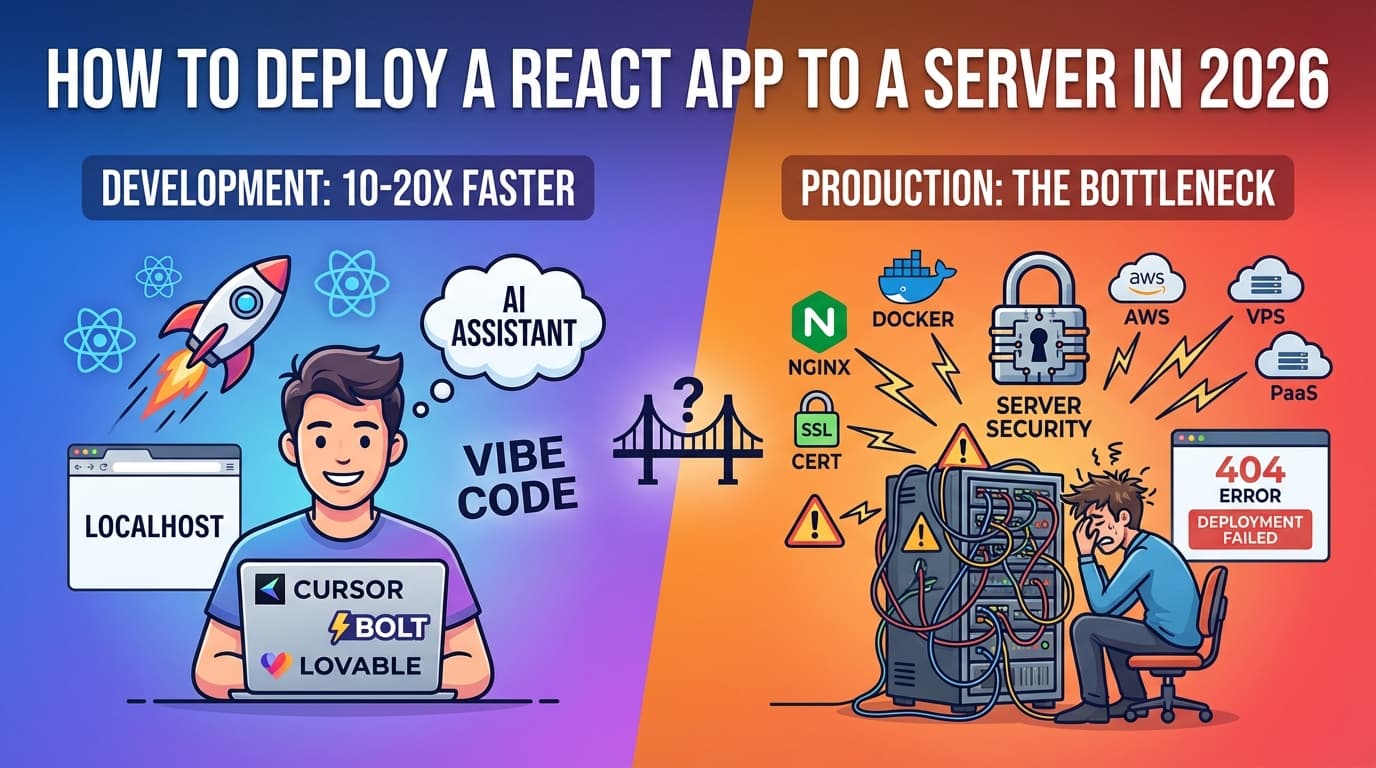
    Building React apps got much faster in the AI coding era. Deploying them did not. Teams can scaffold features in minutes, but production still fails on the same old issues: routing 404s, SSL setup, bad environment handling, DNS mistakes, and surprise billing.

    That friction is not anecdotal. Stack Overflow’s 2024 Developer Survey results highlight deployment-stack complexity as one of the biggest day-to-day frustrations for developers.[1] If your app is “done” but not live, this guide is for you.

    This is a practical deployment guide focused on 2026 realities: AWS options, VPS paths (DigitalOcean and Hetzner), and PaaS shortcuts. It also includes a deployment decision framework so you can choose based on your team’s skill level, budget, and speed requirements.

    Table of contents

    Quick answer: best deployment path by use case

    Your situation Best first option Why
    You want the fastest AWS path with CI/CD AWS Amplify Hosting Repo connect + managed deploy pipeline + built-in SSL/CDN pricing model.[2]
    You want low-cost static hosting on AWS S3 + CloudFront Strong static-hosting economics with global delivery and free-tier allowances.[3][4]
    You need full server control EC2 + Nginx Maximum flexibility, but more setup and ops responsibility.[5]
    You want simple VPS and low ops overhead DigitalOcean Droplet Straightforward UX and predictable baseline experience.[6]
    You optimize heavily for raw price/performance Hetzner Cloud Very aggressive resource pricing and high included traffic quotas.[7]
    You want one-click deployment without deep DevOps Dublyo PaaS flow with 4 providers and server-cost model from $4.60/month.[8][9]

    Before you deploy: non-negotiable React production checks

    1) Build a production artifact, not a dev server

    For Vite-based React apps, the production flow starts with vite build, which outputs an artifact designed for static hosting.[10] You should deploy dist/ (or your configured output directory), not your local dev runtime.

    2) Handle SPA routing correctly

    Single-page apps must route unknown URLs back to your app shell (index.html). React Router explicitly calls this out: direct all URLs to index.html for SPA mode.[11] If you skip this, deep links like /dashboard will 404.

    3) Validate server fallback behavior

    On Nginx-based setups, use try_files fallback rules so missing files fall back to your SPA entry point.[12] This is the most common production routing miss on VPS/EC2.

    4) Keep environment variable strategy explicit

    Most React/Vite environment variables are injected at build time, not runtime. Plan this before deployment. If you need runtime config switching, design for it explicitly (for example via server-injected config JSON).

    AWS deployment paths (Amplify, S3 + CloudFront, EC2, Elastic Beanstalk)

    A) AWS Amplify Hosting: fastest managed AWS route

    Amplify is typically the quickest AWS route for frontend teams because it bundles deployment workflow, CDN delivery, and SSL into a managed experience.[2]

    Typical workflow:

    • Connect GitHub repo
    • Set build settings
    • Deploy
    • Auto-redeploy on push

    What pricing looks like (official signals):

    • Build: standard instance billed at $0.01/min after included allowance[2]
    • Data transfer out: $0.15/GB after included allowance[2]
    • AWS example scenario shows about $8.08/month for a small active app profile[2]

    Best for: teams who want AWS-native CI/CD with minimal infrastructure management.

    Main tradeoff: cost scales with usage and can become significant at higher traffic.

    B) S3 + CloudFront: strong static delivery economics

    For static React SPAs, S3 + CloudFront remains one of the best AWS patterns when configured correctly.[3][4]

    Why teams choose it:

    • S3 handles static object storage
    • CloudFront handles edge delivery and caching
    • CloudFront pay-as-you-go includes always-free monthly allowances (for example 1 TB DTO and 10M HTTP(S) requests)[4]

    Critical React SPA gotcha: if deep links return 403/404 from origin, configure CloudFront custom error behavior to return your SPA entry page instead.[13]

    Main tradeoff: setup is less “one-click” than Amplify and requires correct CDN error/route handling.

    C) EC2 + Nginx: full control, highest ops burden

    EC2 gives maximum flexibility: custom OS, custom Nginx, custom process management, custom networking. It also gives you all the operational burden that comes with that flexibility.[5]

    What usually takes time:

    • SSH access and key management
    • Nginx and routing fallback rules
    • TLS setup and renewals
    • Firewall/security group and networking setup

    AWS costs people underestimate on EC2 stacks:

    • Public IPv4 addresses are billed (in-use and idle examples shown in AWS VPC pricing docs)[14]
    • NAT Gateway has hourly + data processing charges (example rate shows $0.045/hour + $0.045/GB in listed region example)[14]
    • Route 53 hosted zones are $0.50/zone/month for first 25 zones[15]
    • Internet egress and transfer charges accumulate as traffic grows[5]

    Best for: teams needing tight infrastructure control or custom network topology.

    Main tradeoff: slowest path to reliable production for most small teams.

    D) Elastic Beanstalk: not ideal for simple React SPA hosting

    AWS states there is no additional Elastic Beanstalk platform fee, but you still pay for underlying AWS resources (EC2, ELB, etc.).[16] For frontend-only React apps, this is often more moving parts than necessary.

    VPS deployment paths (DigitalOcean and Hetzner)

    DigitalOcean: easier VPS onboarding for many developers

    DigitalOcean is a common VPS default because docs, UX, and workflow are straightforward. Droplets page positions entry plans at $4/month and highlights a 99.99% SLA messaging for droplets.[6]

    Two practical choices:

    • Droplet + Nginx: full VPS approach (more control, more ops)
    • App Platform: managed deploy flow, free static tier options and paid plans starting at $5/month[17]

    DigitalOcean App Platform currently documents free static-site capacity for up to 3 static apps with 1 GiB allowance per app and paid plans starting at $5/month.[17]

    Hetzner Cloud: top value for cost-sensitive teams

    Hetzner Cloud remains one of the strongest value options for raw VPS resources. The pricing page highlights plans such as CX23 and large included traffic allowances (for many EU plans, 20 TB included traffic is shown).[7]

    Best for: Linux-comfortable builders focused on maximum performance per dollar.

    Main tradeoff: fewer managed abstractions than turnkey PaaS flows.

    PaaS shortcut for fast shipping (Dublyo)

    If your bottleneck is deployment complexity, not coding speed, Dublyo is built for that exact gap.

    Dublyo’s current positioning is: pick server, pick app/repo, one-click deploy, and go live with SSL and domain setup flow included.[8] It also documents provider options across Hetzner, Vultr, DigitalOcean, and OneProvider.[9]

    Key details from public Dublyo pages/docs:

    • Starting plans from $4.60/month, with Standard listed at $8.20/month[8]
    • 100+ pre-configured templates and GitHub deployment path[8]
    • One-click deployment messaging with under-2-minute go-live claim[8]
    • 99.9% uptime messaging on main/WordPress pages[8][18]

    Why this matters for React deployment: you avoid hand-rolling Nginx, SSL, and server bootstrap steps for every new app while keeping a server-based cost model for multi-app portfolios.

    How the pricing model differs from per-app platforms

    Managed frontend platforms are excellent for speed, but billing behavior differs a lot once you run multiple apps and environments. Official pricing pages for Vercel, Railway, Netlify, Render, and Heroku show plan structures that can scale by seats, services, runtime, or usage.[20][21][22][23][24]

    That does not make those platforms worse. It just means you should model cost shape before committing:

    • How many apps/services will run in 3-6 months?
    • Will you pay per seat, per service, or per server?
    • Will preview environments and background workers increase monthly baseline?
    • Are free-tier constraints (for example sleep behavior) acceptable for your use case?[25]

    Deploying from VS Code/Cursor workflow

    For teams that still deploy to VPS manually, remote editor workflow can speed operations significantly.

    VS Code Remote-SSH lets you open remote folders and work directly on remote hosts with extensions and terminal support.[19] A simple flow is:

    • git pull on remote
    • npm ci or npm install
    • npm run build
    • sync build output to served directory
    • sudo nginx -t and reload

    Cursor users can use similar SSH-based workflows, but the most stable and best-documented baseline remains the VS Code Remote-SSH path.

    Most common React deployment failures (and fixes)

    1) Deep links return 404/403

    Cause: Host tries to resolve URL as file path.
    Fix: Configure SPA fallback to index.html (CloudFront custom errors, Nginx try_files, host-specific redirects).[11][12][13]

    2) HTTPS works intermittently

    Cause: DNS not fully propagated or certificate mismatch.
    Fix: verify DNS target, CNAME/A records, and certificate issuance status before cutting traffic.

    3) Builds succeed locally but fail in CI

    Cause: environment mismatch, lockfile drift, memory limits.
    Fix: pin Node version, use deterministic installs, mirror CI env vars locally.

    4) Costs spike unexpectedly

    Cause: hidden network and idle infra charges.
    Fix: review IPv4, NAT, DNS zones, and transfer billing monthly on AWS.[14][15]

    Which option should you choose in 2026?

    Use this simple decision framework:

    • You are solo or a small startup, need speed, and want minimal ops: start with Dublyo or another managed PaaS path.
    • You need strict AWS alignment and managed CI/CD: start with Amplify.
    • You need lowest-level control: choose EC2 or VPS.
    • You only host static frontend and want low ops: S3 + CloudFront or a static hosting platform.

    Practical recommendation for most builders in 2026: deploy your first production version on the simplest reliable path, then optimize infra later. Shipping beats perfect architecture when you are still finding product-market fit.

    FAQ

    What is the easiest way to deploy a React app in 2026?

    For most teams: managed platforms like Amplify, App Platform, Netlify, Vercel, or Dublyo. If you need custom server behavior, move to VPS or EC2.

    What is the cheapest way to host a React SPA?

    Usually static hosting paths (S3 + CloudFront, static site platforms, or low-cost VPS) depending on traffic and egress profile. Check transfer pricing before deciding.[3][4]

    Is EC2 overkill for React frontend-only apps?

    Often yes, unless you specifically need custom infrastructure control, custom reverse proxy logic, or unified hosting with backend services.

    Why do React routes break after deployment?

    Because server/CDN routing defaults don’t automatically behave as SPA routing. Configure fallback to index.html on unknown routes.[11]

    Where does Dublyo fit in this landscape?

    Dublyo is a low-cost PaaS option for teams that want one-click deployment and multi-provider flexibility without building DevOps workflows from scratch.[8][9]

    Try deploying your React app on Dublyo


    References (checked February 21, 2026)

    1. Stack Overflow: 2024 Developer Survey results summary
    2. AWS Amplify Hosting pricing
    3. Amazon S3 pricing
    4. Amazon CloudFront pay-as-you-go pricing
    5. Amazon EC2 On-Demand pricing
    6. DigitalOcean Droplets
    7. Hetzner Cloud pricing
    8. Dublyo homepage and pricing highlights
    9. Dublyo docs (providers and deployment workflow)
    10. Vite: building for production
    11. React Router SPA guide
    12. NGINX try_files directive
    13. CloudFront custom error responses
    14. Amazon VPC pricing (NAT Gateway and public IPv4 examples)
    15. Amazon Route 53 pricing
    16. AWS Elastic Beanstalk pricing
    17. DigitalOcean App Platform pricing
    18. Dublyo WordPress page (uptime and multi-cloud messaging)
    19. VS Code Remote-SSH documentation
    20. Vercel pricing
    21. Railway pricing
    22. Heroku usage and billing
    23. Netlify pricing
    24. Render pricing
    25. Render free tier limitations
  • Top 10 cloud service providers in 2026: a complete guide

    Top 10 cloud service providers in 2026: a complete guide

    The cloud market in 2026 is moving faster than most teams can evaluate it. New AI workloads are driving infrastructure demand, hyperscaler pricing keeps changing, and many startups are realizing they overpay for convenience.

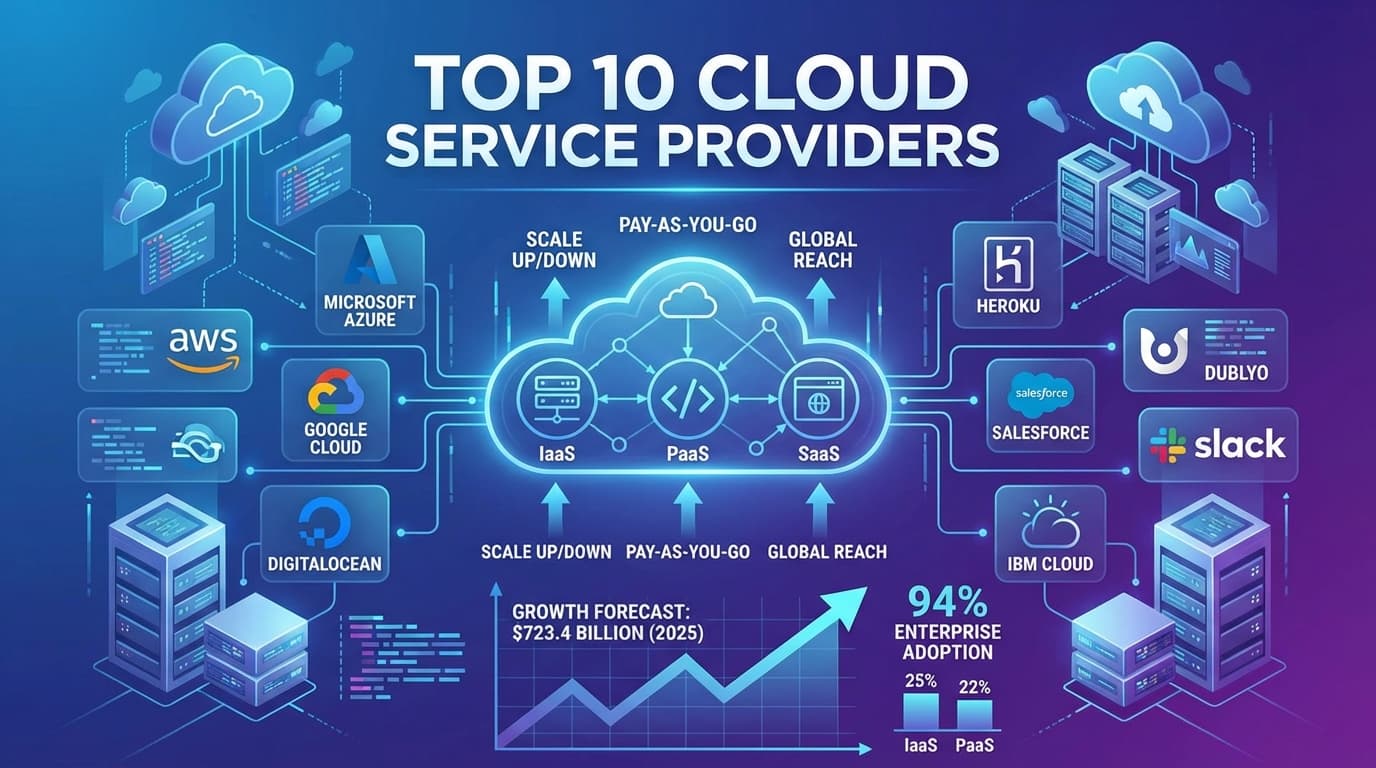
    According to Synergy Research Group, global cloud infrastructure services revenue reached $119.1 billion in Q4 2025 and $419 billion for full-year 2025, with AWS, Microsoft Azure, and Google Cloud at 28%, 21%, and 14% market share respectively.[1] Gartner separately forecast public cloud end-user spending at $723.4 billion in 2025.[2]

    That growth is great for innovation, but it also makes provider selection more expensive when you get it wrong. This guide is built to help you choose with less guesswork.

    Table of contents

    What is a cloud service provider?

    A cloud service provider (CSP) gives you compute, storage, networking, databases, and managed software services over the internet. Instead of buying hardware up front, you rent resources as you go.

    In practice, most teams choose between three service models:

    • IaaS (Infrastructure as a Service): raw servers, storage, networking. Best when you need maximum control.
    • PaaS (Platform as a Service): managed deployment layer for apps. Best when you need speed and less ops overhead.
    • SaaS (Software as a Service): finished software product. Best when you need outcomes, not infrastructure decisions.

    In 2026, the strategic split is clear: hyperscalers dominate enterprise breadth, while leaner platforms compete on simplicity and cost efficiency.[1][27]

    Quick comparison: top cloud providers in 2026

    Provider Best for Pricing signal Main tradeoff
    AWS Largest cloud service catalog and enterprise scale Up to $200 credits for new Free Tier users[4] Complex pricing and architecture decisions
    Microsoft Azure Microsoft-heavy organizations and hybrid enterprise estates $200 credit for 30 days on free account[6] Can be complex for small teams
    Google Cloud AI/ML, analytics, and data-intensive products $300 credit for 90-day trial[8] Smaller enterprise ecosystem than AWS/Azure in some verticals
    Dublyo Low-cost PaaS with fast deployment for builders From $4.60/month, server-cost model[22] Narrower service scope than hyperscalers
    Oracle Cloud (OCI) Oracle-centric and cost-performance focused workloads $300 trial + Always Free services[10] Smaller ecosystem than top hyperscalers
    IBM Cloud Regulated sectors and governance-heavy use cases Free tier + onboarding credits[13] Usually not the cheapest general-purpose host
    DigitalOcean SMB and developer simplicity Droplets from $4/month[15] Less depth for complex enterprise architecture
    Alibaba Cloud Mainland China and APAC-focused execution Price cuts up to 59% on selected products in selected regions[17] Fit can vary for global-first teams outside APAC/China
    Vultr Cost-focused cloud compute and fast provisioning Cloud compute from $2.50/month[18] Less managed-platform depth vs hyperscalers
    Akamai Connected Cloud (Linode) Affordable cloud compute + broad edge reach Shared CPU from $5/month[20] Product surface smaller than hyperscalers

    All prices are directional and may vary by region, usage pattern, billing terms, and optional services.

    Deep review: top 10 cloud service providers

    1) Amazon Web Services (AWS)

    AWS remains the biggest cloud business by revenue and one of the strongest default choices for complex systems. Amazon reported $35.6 billion AWS revenue in Q4 2025 and $128.7 billion for full-year 2025.[3]

    It still leads market share, though the gap is narrowing as Azure and Google continue accelerating.[1]

    • Best for: Enterprise-scale workloads, multi-region production systems, and teams needing deep service breadth.
    • Strengths: Largest mature ecosystem, very broad service menu, strong partner marketplace.
    • Limitations: High complexity in IAM, networking, and cost governance without strong cloud ops discipline.
    • Pricing notes: AWS Free Tier now includes up to $200 credits for new customers under the updated model.[4]

    2) Microsoft Azure

    Azure is the strongest “enterprise integration” cloud for teams already deep in Microsoft identity, productivity, and server ecosystems. Microsoft reported Azure and other cloud services growth of 39% year-over-year in FY26 Q2.[5]

    • Best for: Enterprises running Microsoft-heavy stacks and hybrid deployments.
    • Strengths: Enterprise identity integration, mature hybrid strategy, broad enterprise buying channels.
    • Limitations: Complex billing and governance model for smaller teams.
    • Pricing notes: New accounts can access $200 credit for 30 days with free service tiers.[6]

    3) Google Cloud Platform (GCP)

    Google Cloud has become the growth leader among the top providers for many AI-heavy and analytics-led buying decisions. Alphabet reported Google Cloud revenue of $17.7 billion in Q4 2025, up 48% year-over-year.[7]

    • Best for: AI-native applications, modern data platforms, and advanced analytics teams.
    • Strengths: Strong AI platform momentum, mature data tooling, efficient global backbone.
    • Limitations: Smaller service ecosystem than AWS in some enterprise procurement paths.
    • Pricing notes: $300 free trial credits over 90 days plus always-free products.[8]

    4) Dublyo (best low-cost PaaS pick for many builders in 2026)

    Dublyo is positioned for a different buyer: teams that want to ship quickly without absorbing full cloud-platform complexity or classic per-app PaaS pricing pressure. The platform supports 4 underlying infrastructure providers (Hetzner, Vultr, DigitalOcean, OneProvider) and one-click template deployment workflows.[23]

    Dublyo’s core model is clear: pay actual cloud server cost plus a platform fee, with entry plans starting at $4.60/month and one-click deployment flows for 100+ templates and GitHub projects.[22][23]

    • Best for: Startups, agencies, indie developers, and small product teams optimizing for speed and cost.
    • Strengths: One-click deployment, low entry pricing, multi-provider flexibility, custom domains and SSL workflow built in.
    • Limitations: Not designed to replace hyperscaler depth for advanced enterprise-native architectures.
    • Why it stands out: PaaS convenience while keeping infra economics closer to VPS reality.

    5) Oracle Cloud Infrastructure (OCI)

    OCI continues to gain relevance where price-performance and Oracle ecosystem alignment matter. Oracle reported OCI (IaaS) revenue growth of 68% year-over-year in FY26 Q2 and total remaining performance obligations of $523 billion.[9]

    • Best for: Oracle database estates, performance-sensitive workloads, cost-focused enterprise modernization.
    • Strengths: Strong growth trajectory, deep Oracle integration, aggressive economics narrative.
    • Limitations: Smaller ecosystem than AWS/Azure for broad third-party cloud-native stacks.
    • Pricing notes: OCI trial and Always Free program remain a strong on-ramp.[10] Oracle’s economics page emphasizes lower infrastructure costs vs alternatives.[11]

    6) IBM Cloud

    IBM Cloud remains most relevant in governance-heavy and regulated enterprise environments. IBM reported $67.5 billion full-year 2025 revenue and continued emphasizing hybrid + AI priorities.[12]

    • Best for: Financial services, government, healthcare, and compliance-intensive workloads.
    • Strengths: Enterprise relationships, governance positioning, hybrid legacy modernization fit.
    • Limitations: Less attractive for lean teams prioritizing lowest hosting cost or fastest startup velocity.
    • Pricing notes: IBM provides onboarding credits and free service access tiers.[13]

    7) DigitalOcean

    DigitalOcean is still one of the best simplicity-first clouds for SMB and developer workflows. It reported $230 million Q3 2025 revenue (+16% year-over-year).[14]

    • Best for: Startups and growing teams that want straightforward cloud operations.
    • Strengths: Strong UX, clear docs, predictable product packaging.
    • Limitations: Not as broad as hyperscalers for specialized enterprise services.
    • Pricing notes: Droplets start at $4/month.[15]

    8) Alibaba Cloud

    Alibaba Cloud remains critical for China-focused and many APAC-oriented cloud strategies. Omdia data for Q1 2025 shows Alibaba Cloud at 33% share in Mainland China cloud infrastructure.[16]

    • Best for: Businesses with China-first or APAC-heavy growth strategy.
    • Strengths: Regional reach, local ecosystem leverage, active AI-cloud expansion.
    • Limitations: Cross-region strategy complexity for teams centered on US/EU systems.
    • Pricing notes: Alibaba has announced selected product price cuts up to 59% in selected regions outside Mainland China.[17]

    9) Vultr

    Vultr competes on speed, global availability, and cost-accessible compute. Its solution pages continue to position entry cloud compute from $2.50/month.[18]

    • Best for: Cost-sensitive cloud compute and globally distributed small-to-mid workloads.
    • Strengths: Affordable entry point, straightforward provisioning, broad workload support.
    • Limitations: You may need more self-management than on full PaaS-first platforms.
    • SLA note: Vultr markets a 100% uptime SLA framework.[19]

    10) Akamai Connected Cloud (Linode)

    Linode’s cloud platform under Akamai is a practical choice for teams that want predictable infrastructure pricing plus large-scale edge distribution options. Akamai highlights shared CPU plans from $5/month and a global platform footprint of 4,400+ edge PoPs in 130+ countries.[20][21]

    • Best for: Teams needing affordable cloud compute with edge distribution potential.
    • Strengths: Network reach, simple compute options, solid value baseline.
    • Limitations: Less “all-in-one” managed depth than the largest hyperscalers.

    Workload-to-provider mapping (practical examples)

    If you are still unsure after ranking providers, use your workload type as the final filter. This avoids “brand-first” decisions that usually increase cost.

    Workload type Recommended starting options Why
    Global enterprise platform with strict controls AWS, Azure Broad governance, mature enterprise tooling, deep ecosystem options.
    AI-heavy product with strong analytics dependency Google Cloud, AWS Strong AI/data stack acceleration and managed platform depth.
    Oracle database modernization OCI Tight Oracle integration and aggressive OCI growth/economics positioning.[9][11]
    Regulated-sector hybrid transformation IBM Cloud, Azure Governance-heavy enterprise posture and hybrid execution strengths.
    Startup shipping MVP + API + DB quickly Dublyo, DigitalOcean, Vultr Fast setup, lower baseline cost, simpler day-1 operations.
    Agency managing multiple small client apps Dublyo One-click deployment and server-cost model can reduce multi-app hosting overhead.[22][23]
    China/APAC-first product Alibaba Cloud Regional cloud share leadership and local ecosystem leverage.[16]
    Cost-sensitive global compute footprint Vultr, Akamai Connected Cloud Low entry pricing and broad network/edge positioning.[18][21]

    Hidden cloud cost traps to avoid in 2026

    Most cloud overages are predictable. Teams usually miss them because they focus on instance price and ignore total operating shape.

    • Bandwidth and egress leakage: outbound traffic can become a top-3 cost line item quickly.
    • Always-on staging and preview environments: idle environments quietly compound monthly bills.
    • Per-service multiplication: per-app or per-service billing scales poorly for multi-app portfolios.
    • Seat-based platform pricing: collaboration growth can increase cost without corresponding infrastructure growth.[26]
    • Underused managed services: premium managed components can stay overprovisioned for months.
    • No rightsizing routine: without monthly rightsizing, cloud spend drifts upward by default.

    A practical fix is to pair any provider choice with a monthly cost review cadence and a per-workload target budget.

    How to choose the right cloud provider in 2026

    Use this framework before committing:

    1) Start with billing model, not brand

    Most overspend comes from a billing mismatch, not missing features. If your app portfolio is small and growing, per-app billing can become expensive quickly. If your workloads are highly variable, pay-as-you-go can be efficient but needs strong spend controls.

    2) Match provider to architecture maturity

    Early-stage teams often win with platforms that reduce deployment complexity. Mature platform teams with SRE/FinOps skills can extract more value from hyperscaler depth.

    3) Make region and compliance constraints explicit

    Data residency and sovereign requirements can narrow your viable choices immediately. Gartner highlighted sovereign cloud IaaS momentum in 2026, so this is now a first-order planning question, not an edge case.[28]

    4) Evaluate exit cost before onboarding

    Document what it takes to migrate apps, data, and DNS away from your provider before you commit. If migration playbooks are unclear, lock-in risk is high.

    5) Run a 90-day cost simulation

    Model expected spend for production + staging + background jobs + storage + bandwidth. Include team-seat costs where relevant (for example, collaboration-heavy platforms).

    Why Dublyo stands out for cost-conscious teams

    For teams optimizing for speed + low monthly cost, Dublyo has one of the most practical profiles in this list:

    • Supports 4 infrastructure providers: Hetzner, Vultr, DigitalOcean, OneProvider[23]
    • One-click deployment for templates and GitHub projects[23]
    • Entry pricing from $4.60/month, with clear tiering[22]
    • Model centered on server economics instead of pure per-app rent[22]

    The economics are especially compelling for multi-app portfolios where each extra service on traditional PaaS platforms can increase baseline spend.

    Simple pricing reality check for builders

    Platform Published paid baseline Billing behavior
    Heroku Standard-1X max $25/month per dyno[25] Per-dyno pricing; scales with service count
    Railway Hobby $5 minimum usage (includes $5 usage credit)[24] Usage-based after included credit
    Vercel Pro $20/month + additional usage[26] Seat + usage model for many teams
    Dublyo From $4.60/month, Standard at $8.20/month[22] Server-cost model + platform fee

    Bottom line: if your primary goal is to launch and run multiple apps at the lowest practical cost without managing raw infrastructure yourself, Dublyo is one of the strongest options in this 2026 list.

    Explore Dublyo plans and start deploying

    FAQ

    Which cloud provider is best in 2026?

    There is no universal best provider. AWS, Azure, and Google Cloud remain strongest for broad enterprise use. Cost-focused builders often get better value from simpler platforms like Dublyo, DigitalOcean, or Vultr depending on workload profile.

    What is the cheapest cloud service provider for startups?

    For entry-level compute, Vultr and DigitalOcean have low starting points. For teams that want PaaS convenience with low baseline spend, Dublyo is notable with published pricing from $4.60/month and one-click deployment workflows.[18][15][22]

    Is multi-cloud worth it for small teams?

    Usually yes, but keep it simple. Start with one production provider and one fallback/secondary provider strategy. Avoid splitting every service across clouds too early.

    What matters more: provider market share or product fit?

    Product fit and economics matter more for most teams. Market share is useful for judging ecosystem maturity, but it does not guarantee the lowest cost or fastest shipping velocity for your use case.

    Can I use Dublyo for production?

    Dublyo positions itself as a production-ready low-cost PaaS with automated deployment workflows and clear pricing tiers. As with any platform, validate fit against your own SLA, compliance, and scaling requirements before migration.

    Final verdict

    The top cloud service providers in 2026 split into two clear categories:

    • Hyperscalers (AWS, Azure, Google Cloud) for maximum breadth and enterprise-scale complexity.
    • Cost/simplicity-focused providers (including Dublyo, DigitalOcean, Vultr, and Akamai Connected Cloud) for leaner operations and faster deployment loops.

    If your team is cost-sensitive and shipping multiple applications, Dublyo’s mix of 4 provider options + one-click deployment + low entry pricing makes it one of the most practical choices to evaluate first.


    References (checked February 21, 2026)

    1. Synergy Research Group: Q4 2025 cloud market and market share
    2. Gartner: public cloud end-user spending forecast for 2025
    3. Amazon: Q4 2025 results (AWS revenue)
    4. AWS: Free Tier update (up to $200 credits)
    5. Microsoft FY26 Q2: Intelligent Cloud performance
    6. Azure free account details
    7. Alphabet investor relations: 2025 Q4 earnings call
    8. Google Cloud free trial FAQs ($300 for 90 days)
    9. Oracle FY26 Q2 results (OCI growth)
    10. Oracle Cloud Free Tier
    11. Oracle Cloud Economics
    12. IBM Q4/full-year 2025 results
    13. IBM Cloud free offerings
    14. DigitalOcean Q3 2025 results
    15. DigitalOcean Droplets pricing
    16. Omdia: Mainland China cloud market Q1 2025
    17. Alibaba Cloud pricing notice
    18. Vultr web hosting solution page (starting price)
    19. Vultr service level agreement
    20. Akamai Connected Cloud essential compute pricing
    21. Akamai global infrastructure overview
    22. Dublyo homepage (pricing and positioning)
    23. Dublyo documentation (providers and deployment workflows)
    24. Railway pricing
    25. Heroku usage and billing (Standard-1X pricing)
    26. Vercel pricing
    27. Synergy: cloud market share trends (Q3 2025)
    28. Gartner: sovereign cloud IaaS spending projection for 2026